






Phone and mobile data on a cruise without a shock bill
Out at sea, your phone can join the ship's own mobile network, which reaches land by satellite. EU roaming rules only cover land-based networks, so that connection is billed at whatever your operator decides, and regulators warn it can mean bill shock. Switch on Airplane Mode when the ship sails, turn Wi-Fi back on if you have a ship package, and use mobile data in port, where you are on land networks again: roam like at home in EU and EEA ports, or a travel eSIM in the countries it covers.
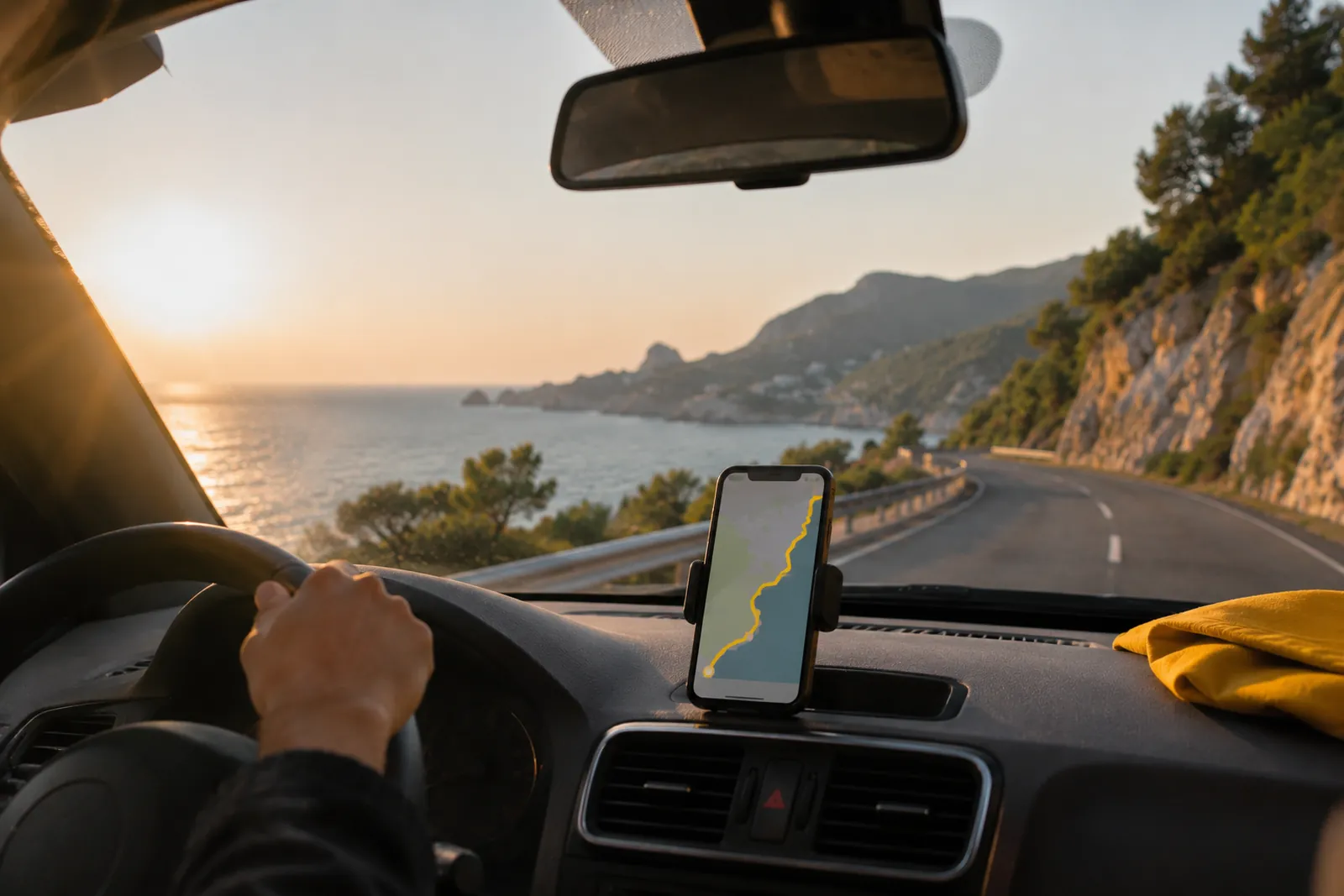
The ship carries its own mobile network
There are no masts in open water, so many ships bring one with them. Telenor, whose maritime unit runs the service on many vessels, describes it as radio networks installed on board and linked to public networks via satellite, operated through roaming agreements with mobile operators around the world. Ferry companies such as Stena Line and Irish Ferries name Telenor Maritime as the provider of the network on their ships.
On cruise lines in the Americas the service is often called Cellular at Sea. Celebrity Cruises says it works once the ship is 12 nautical miles from land, usually about an hour after leaving port, and that calls, texts and data then travel by satellite with international roaming charges.
For your phone, the ship's network is simply another foreign operator. If the line is allowed to roam, it can connect without you doing anything, which is why Romania's regulator ANCOM points out that these services can start without any action from the user.
 One eSIM for 33 European countries
Several countries on one trip? Same eSIM, same data, no swapping lines at the border.
Black Friday −25 % Ends in 27d 15:45:44Choose your data
For one to two weeks of maps, messaging and the odd video.
Buy up to 180 days before you fly: the plan only starts when the eSIM connects at your destination.
Write the email where we should send the QR code.
We send the QR code and your receipt here. No spam.
QR in your inbox in minutes · If it does not connect, we fix it · Secure payment with Stripe
Will it work on my phone?
On iPhone: Settings → General → About, and scroll to EID. If there is an EID, your phone takes eSIMs. Every iPhone from the XS (2018) onwards does.
On Android: Settings → About phone → Status, and look for EID. If there is an EID, your phone takes eSIMs. Most Galaxy S20, Pixel 3 and later do.
It also has to be carrier-unlocked. If you bought it outright or your contract is over, it almost certainly is.
Not sure about your model? Ask us before you pay and we will tell you — a person answers within 24 hours.
How it works
- 1Choose and payCard, Apple Pay or Google Pay. No account.
- 2Install it at homeThe QR arrives by email. Scan it on wifi in a minute.
- 3Connect when you landTurn on data roaming for the eSIM and you are online.
EU roaming rules stop where the land network ends
The EU's Your Europe portal is clear on the split. On a ship or a plane you should not pay extra as long as the phone is on a land-based mobile network. Once it is connected via satellite, EU rules no longer apply, the roaming is unregulated and there are no price caps. Ireland's regulator ComReg says the same: these services are not covered by roam like at home.
Who sets the price is your own operator, not the ship. Irish Ferries says that neither it nor Telenor Maritime sets the tariffs and that the satellite service costs more than your normal tariff. Stena Line says calls are charged at international mobile rates, which can be high. ANCOM warns that even short use of these unregulated networks can cause bill shock.
There are some safeguards. ComReg says your operator must send an automatic message when the phone connects to one of these networks, explaining the extra charges, and may offer an opt-out from roaming on planes and boats. ANCOM adds that for data, including satellite connections, the operator must warn you and ask before you carry on at 50 and 100 euros, excluding VAT. Useful, but the text arrives once you are already connected: it is a warning, not a barrier.
How to keep your phone off the ship's network
- Airplane Mode when the ship sails. Your Europe, ANCOM and Celebrity all suggest it. On an iPhone, tap the Airplane Mode button in Control Center; on a Pixel, Settings, Network and internet, Airplane mode.
- Wi-Fi back on inside Airplane Mode. Apple says Wi-Fi, Bluetooth and cellular switch off but you can turn Wi-Fi back on while Airplane Mode stays on. Google says a Pixel remembers that choice the next time you use Airplane mode.
- Data roaming off on your usual line. On an iPhone, Settings, Cellular, Cellular Data Options, Data Roaming; with two lines, tap the number first. Your Europe offers this as the alternative to Airplane Mode.
- Ask your operator whether it can block maritime roaming. ComReg says operators may offer that opt-out, and ANCOM suggests using it if yours does.
The difference between the first and third steps matters. Data roaming governs internet on that line, while Airplane Mode turns the cellular radio off completely, so calls and texts cannot ride the ship's network either. That is why it is the safer setting for the hours at sea. The details of the third one are in how to turn off roaming on your home line.
On Android you can also pin the phone to a land operator in port. Google's steps for a Pixel are Settings, Network and internet, SIMs, the SIM, then turn off Automatically select network; on Samsung it is Connections, Mobile networks, Network operators. Google says the list can take up to two minutes to appear and that you should switch automatic selection back on when you move on. The method and its pitfalls are in manual vs automatic network selection.
Ship Wi-Fi: the internet that does not go through your SIM
Cruise lines sell their own Wi-Fi packages, paid on board or before sailing, not through your mobile operator. Celebrity, for example, offers a basic tier for browsing, email and messaging, and a premium tier for sharing photos and videos, video calls and phone calls, and says its internet is powered by Starlink. It also says booking before the cruise can save up to 10 percent, and that the basic tier can only be bought in advance or as part of a bundle.
Irish Ferries gives the simplest advice for anyone worried about roaming costs: switch mobile data off and use the ship's Wi-Fi instead. With Airplane Mode on and Wi-Fi on, messaging apps and calls over the internet work through the package, and your SIM stays out of it.
Before buying, check what the package actually allows. A tier without calls or video can still be enough for messages and maps downloads, and Celebrity notes that cruise terminals and some port destinations offer free Wi-Fi.
In port you are back on land networks
Near land, the phone uses an ordinary mobile network on shore. Irish Ferries says that close to land you are on a terrestrial network under EU roaming rules, and Your Europe says there is no extra charge on a ship while you are on a land-based network. So the question in each port is simply which country you are in.
In EU ports, an EU plan roams like at home. Your Europe says this regime also applies in the European Economic Area, which includes Norway, so a fjords cruise calling at Bergen, Geiranger or Tromsø is covered on land. In ports outside the EU and EEA, which on a Mediterranean cruise can include Turkey, Morocco or Tunisia, and in many Caribbean islands, Your Europe says roam like at home does not apply, and your operator's normal roaming prices for that country do.
Before switching Airplane Mode off in port, look at which network the phone has chosen. The checks are in which network is my phone on abroad, and what your plan includes inside the EU is in roam like at home explained.
What a travel eSIM does on a cruise, and what it does not
A travel eSIM from Snoozim uses land mobile networks only. At sea, out of reach of land masts, it simply has no service: it does not connect to the ship's network, so it cannot run up charges there. Where it helps is in port and along coasts within reach of land networks, in the countries its plan covers.
Three examples. On a Mediterranean cruise, check the countries in the plan against each port of call, since some stops may be outside the EU. On a Norwegian fjords route, a Norway pack connects to Norwegian networks in port and wherever land coverage reaches the ship. On a Caribbean cruise, a country pack works in the ports of that country only, which is where non-EU roaming on your usual line would otherwise apply. Validity starts when the eSIM first connects at the destination, so it does not count down while you sail there.
The routine is short. Install the eSIM at home from the QR code that arrives by email after payment, set it as the data line and turn your usual line's data roaming off. In port, switch Airplane Mode off and the eSIM carries the data; the hotspot can share it with the rest of the cabin. Before sailing, Airplane Mode goes back on. If you run low, a top-up goes onto the same eSIM.
Travelling later?
We remind you before your trip
Tell us the day you leave. We email you a week before and the day before with the steps to install the eSIM on Wi-Fi at home. Nothing else.
We only write about this trip, and every email has a one-click unsubscribe. Privacy policy
Does EU roaming work on a cruise ship?
Only while the phone is on a land-based network, such as in an EU port or near the coast. Your Europe says that once it connects via satellite, EU rules and price caps no longer apply.
Is Airplane Mode enough to avoid charges at sea?
It is the safest option, because it turns off the cellular connection for calls, texts and data. Apple and Google both let you turn Wi-Fi back on while Airplane Mode stays on.
Will a travel eSIM work in the middle of the sea?
Not a land-network eSIM like Snoozim's. It only connects to land mobile networks, so it works in port and within reach of coastal masts, and has no service in open water.
Is the ship's Wi-Fi charged to my phone bill?
No. Ship Wi-Fi packages are sold by the cruise line. What reaches your phone bill is the use of the ship's mobile network, at prices set by your own operator.
Can my operator block the ship's network for me?
Some can. Ireland's regulator ComReg says operators may offer an opt-out from roaming on planes and boats, so ask yours before you sail.
Get your eSIM before you fly: the QR arrives by email in minutes and the plan only starts when you connect at your destination.
See eSIM prices